← ALL PROJECTS

PROJECT 04 / 07 · Python / Document Intelligence / Retrieval-Based Software

Turning documents into conversations.

Corpus Forge — Local Retrieval Studio

Select the source. Inspect the evidence. Shape the output.

2026Working local development prototype, subject to code verification
LOCAL DEVELOPMENT PROTOTYPE
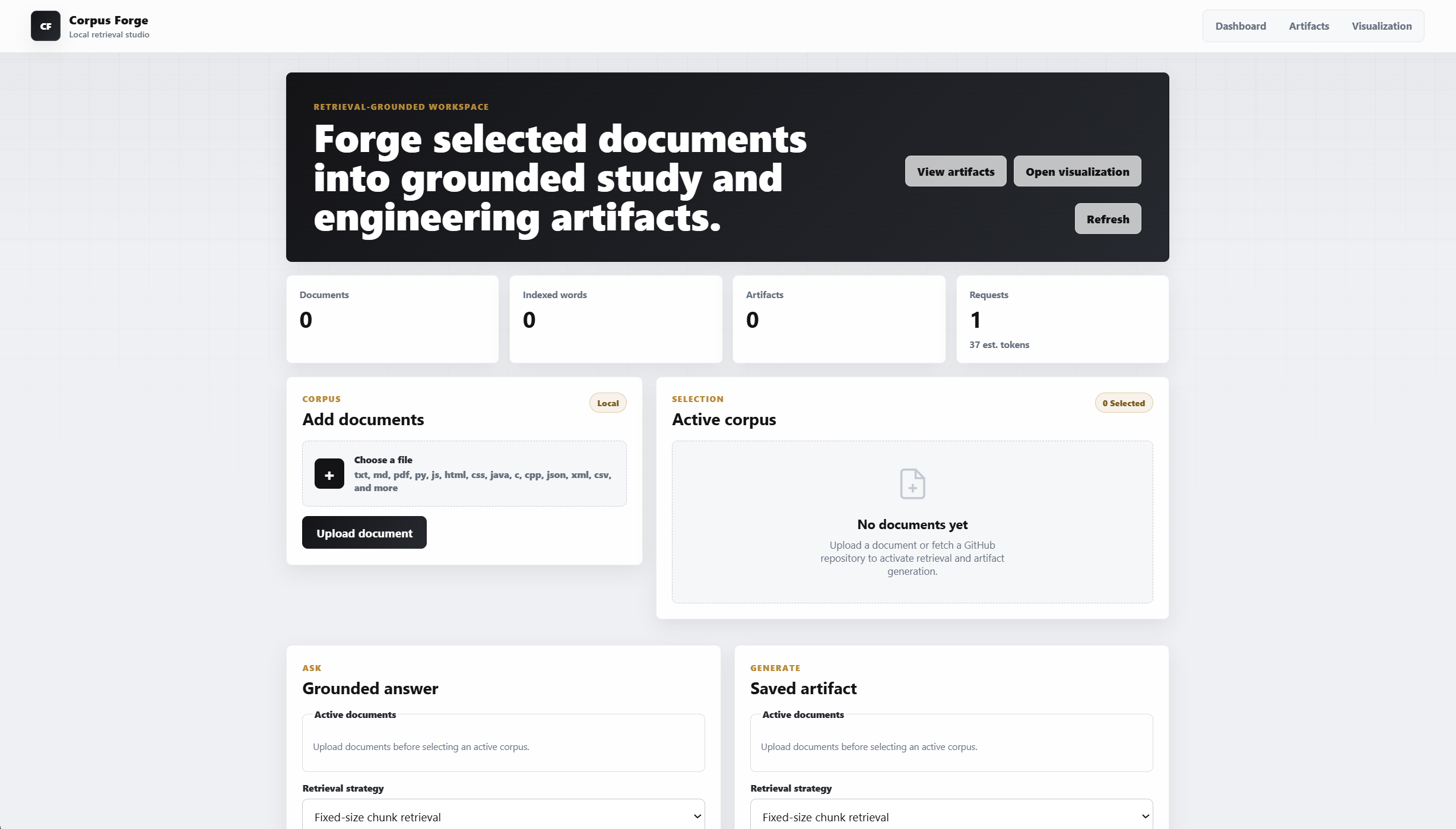
Corpus Forge local document workspace with upload controls, an empty active corpus and zero documents and indexed words.
Corpus Forge — Local Retrieval StudioActual application capture · local prototype
SCROLL FOR THE STORY ↓

01 / THE CONTEXT

The challenge.

Make varied document content accessible to an AI-assisted application while preserving a clear user experience and manageable ingestion pipeline.

02 / MY ROLE

Work with
purpose.

Collaborative academic engineering and local development around document ingestion, retrieval and frontend/backend integration. Detailed individual module ownership is not assigned here without the team record.

03 / ENGINEERING NOTES

01

Worked in a collaborative Flask application environment with document ingestion, active corpus selection, a JavaScript interface and SQLite persistence for documents and artifacts.

02

Explored local-file and GitHub-source ingestion, normalization, lexical chunk/file retrieval and local extractive generation. A synthetic upload → retrieval → saved-flashcard workflow was independently exercised for this portfolio.

03

Developed experience with document-intelligence architecture that informed StudyForge AI. Gemini API and RAG were earlier design directions; the verified local version uses no LLM call, semantic embedding database or vector-search service.

04 / HIGH-LEVEL SYSTEM

From idea to structure.

Public-facing conceptual overview — not a disclosure of internal implementation.

STEP / 01Select & normalize documents01
STEP / 02Lexical chunk / file retrieval02
STEP / 03Extractive answers · SQLite artifacts03

05 / THE STACK

The tools
behind the work.

PythonFlaskSQLiteLexical retrievalExtractive generationJavaScriptHTML/CSSDocument ProcessingPytest

06 / MOTION STUDY

See the concept.

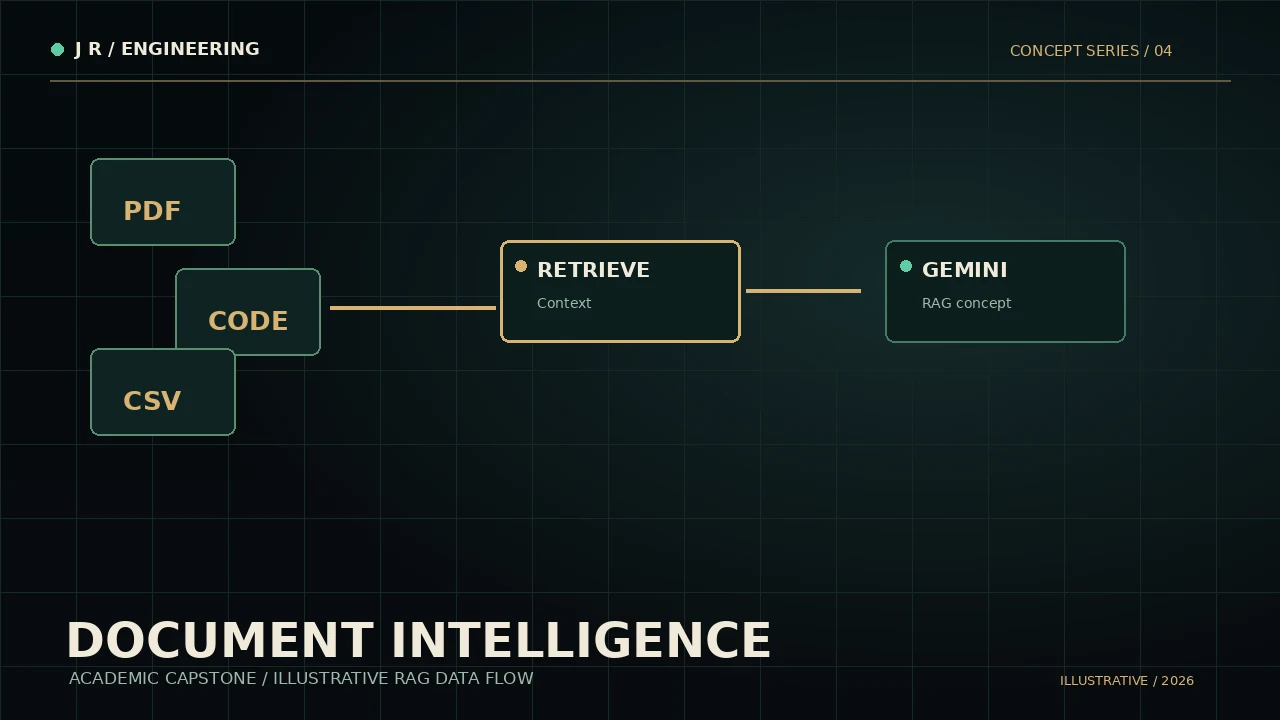
Conceptual ingestion illustration — not a live Gemini API call.

FIG. / 04
DOCUMENTSLocal · GitHub
INGESTIONParse · Structure
RETRIEVALRelevant context
LOCAL SYNTHESISExtractive answers
CONCEPT / VISUAL STUDY

Original illustrative concept, not recorded production footage, a real transaction, or an operational system.

07 / EDITORIAL VISUAL

Ideas in motion.

A cinematic interpretation of the public project story—not internal source code or a production demonstration.

Earlier capstone retrieval concept. The inspected local version uses lexical retrieval and extractive generation; no connected model is shown.
CONCEPT / VISUAL STUDY 2026
Context before responseEarlier capstone retrieval concept. The inspected local version uses lexical retrieval and extractive generation; no connected model is shown.
ORIGINAL VISUAL / STILL

CORPUS FORGE / IMPLEMENTATION & EVIDENCE

A local foundation.
A traceable next step.

CURRENT LOCAL IMPLEMENTATION

Lexical retrieval, inspectable outputs.

Flask and a plain JavaScript interface connect document parsing, selected-source retrieval and SQLite storage. BM25-style scoring ranks overlapping chunks or whole files, with word ranges, matched terms and retrieval diagnostics.

The generator selects source sentences and builds answers or flashcard templates. It makes no model call. Audience, tone and creativity controls are visible, but their presence does not establish LLM-level style control or semantic understanding.

FOCUSED LOCAL VERIFICATION

Real sample. Limited conclusions.

38 existing local tests passed. In a fresh, isolated data store, an authored synthetic Markdown file was uploaded and selected, a focused question retrieved the explicit source fact, and a flashcard artifact was saved and survived reload.

A longer question retrieved the right passage but its summary omitted the requested interval. A focused lexical query returned it in the summary itself. Answer quality, unsupported formats, large-corpus behavior and production safeguards need broader evaluation.

READ THE SYNTHETIC SAMPLE
RELATIONSHIP TO STUDYFORGE AI

One engineering path, two distinct prototypes.

Corpus Forge’s capstone work provided document-processing and retrieval experience that preceded StudyForge AI. StudyForge extends that learning into a student workspace with FastAPI, course-scoped tutoring, practice and progress, alongside jobs and document assistance.

The Flask/SQLite implementation here remains a local extractive system. Earlier Gemini API and RAG plans explain the exploration; they are not a deployed model integration. StudyForge’s own page separates implemented adapters, offline tests and pending live acceptance.

EXPLORE STUDYFORGE AI
PROJECT SCOPE

Academic team project and local development prototype. Focused local workflows and tests do not establish production security, retrieval quality across arbitrary documents or learning effectiveness. Demonstrations use an authored synthetic sample. The public repository is the original scaffold/documentation snapshot, not the complete local application.

OPEN PUBLIC SCAFFOLD & DOCUMENTATION ↗

Repository reviewed 10 November 2026: the public main branch contains the original scaffold and documentation. The runnable local Flask application shown in these captures is absent from that snapshot.