Learn from the course.
Select a course and documents, retrieve page-linked evidence, then move through explanation, a question, hints and practice. The local source-reader mode remains separate from provider-powered teaching.
PROJECT 06 / 07 · Applied AI / Education Technology
StudyForge AI — Student Learning Workspace
Course evidence. Guided practice. A student’s next step.
01 / THE CONTEXT
Students move between lecture files, practice, job searches and administrative paperwork. StudyForge explores a coherent workspace that keeps course evidence close to learning, while giving jobs and document preparation their own clearly sourced workflows.
02 / MY ROLE
Developing the student-companion product through requirements, API integration, document retrieval, tutoring workflows and testing. It extends supplied StudyForge v2 and earlier academic Corpus Forge processing work, with AI-assisted implementation; it is not presented as an entirely new or exclusively individual codebase.
03 / ENGINEERING NOTES
Built around a FastAPI service and a plain HTML/CSS/JavaScript workspace, with SQLite persistence for selected course materials, conversations, activities and progress.
Developed page-aware document ingestion, scoped retrieval, provider adapters, citation validation and a persistent tutor-state workflow. Controlled tests exercise explanations, hints, retries, grading and saved practice.
Added supporting jobs-provider adapters and French document-preparation workflows. Live provider behavior is separated from offline contract tests and the remaining production roadmap.
04 / HIGH-LEVEL SYSTEM
Public-facing conceptual overview — not a disclosure of internal implementation.
05 / THE STACK
06 / MOTION STUDY
An original, interactive learning journey: choose a course, process a sample document, inspect a citation, try an exercise and follow the practice record. Supporting modules remain distinct from the tutor.
A STUDENT’S STARTING POINT
One course. A clear goal.
A place to begin.
A student selects Plant Biology and chooses to understand water transport.
Scripted portfolio illustration · Authored sample material · No files uploaded or external services contacted · Sample progress resets on Restart.
Scripted learning journey with authored sample text, sample progress and fictional supporting workflows. Not a recording of live AI or connected services.
STUDYFORGE AI / LOCAL WORKSPACE / PROJECT CAPTURES
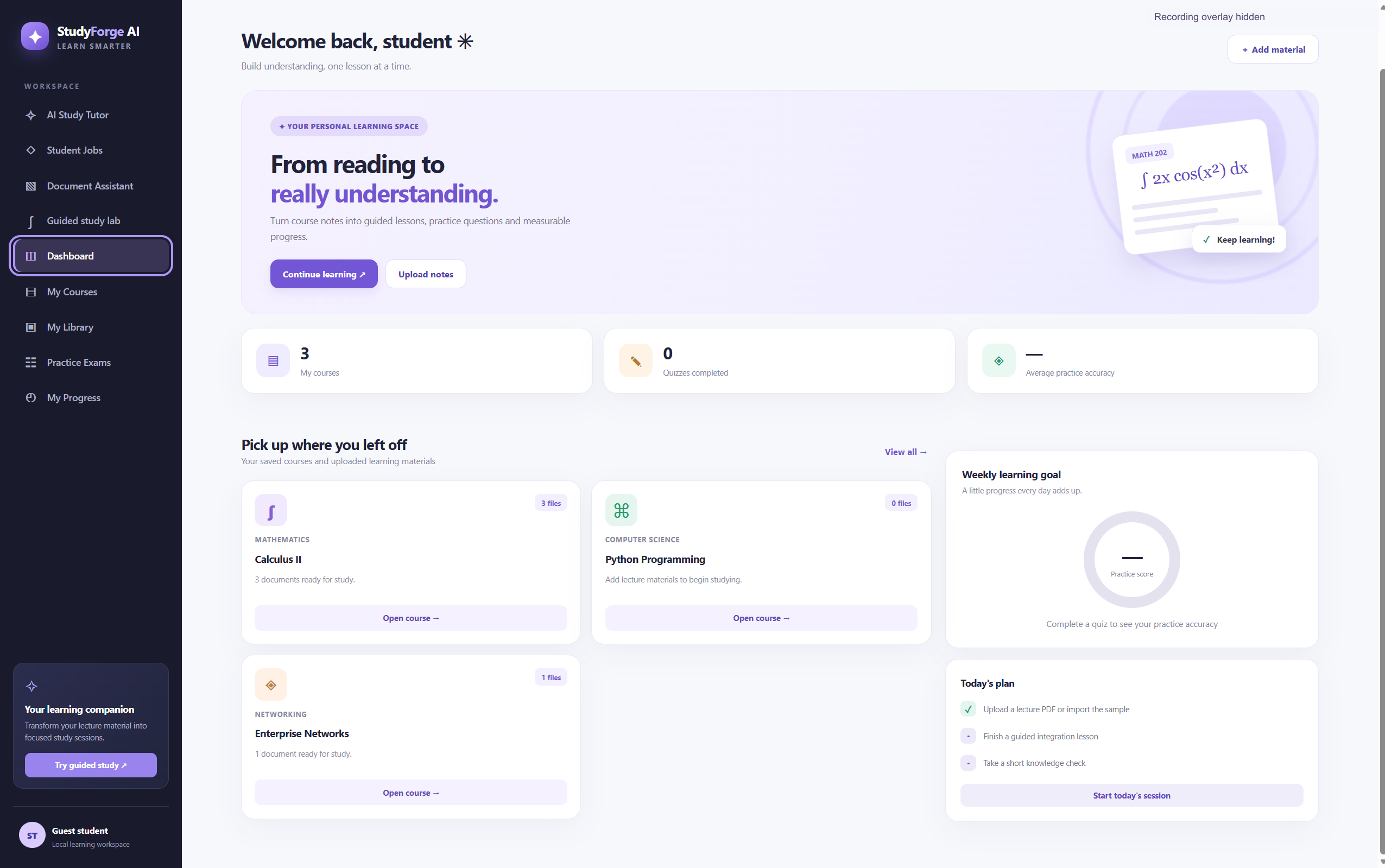
Authentic local application captures, ordered from course context to practice and progress. Select a view, then enlarge it to inspect the interface.
Working local prototype, under active development. This captured version uses local lexical retrieval. Provider configuration does not establish a verified AI tutoring session or live vector-search RAG.
Course selection, document context, consent controls and the conversation area. The tutor is ready but no generated answer is shown. The provider is configured, not yet verified, and retrieval is local lexical search.
Private document names redacted; recording overlay hidden.07 / THE PRODUCT VISION
The tutor is the main learning workflow. Courses, library and progress are supporting views, rather than extra product pillars.
Select a course and documents, retrieve page-linked evidence, then move through explanation, a question, hints and practice. The local source-reader mode remains separate from provider-powered teaching.
Saved preferences, provider-backed listings, deduplication and original application links. Himalayas and Adzuna adapters exist; coverage, credentials and licensing remain provider-specific. No auto-application.
French preparation workflows, dated official-source references, editable checklists and draft correspondence. Optional private text checks stay local. Information support does not establish authenticity or official eligibility.
08 / IMPLEMENTATION & EVIDENCE
The local source has moved beyond the original architecture proposal. Implementation, controlled verification and live acceptance are different levels of evidence.
FastAPI and SQLite; a plain HTML/CSS/JavaScript frontend; page-aware ingestion; scoped retrieval; persisted tutor states, hints, retries and practice; jobs-provider contracts; administrative checklists and editable drafts.
62 focused offline service tests passed independently during this portfolio integration. Model and jobs responses in these tests are controlled fixtures.
Supplied local captures show the student workspace, source-attributed Himalayas listings, practice controls and recorded activity. The tutor view explicitly reports local lexical retrieval and an AI provider configured but not yet verified.
Screenshots are visual evidence, not an independent replay of provider calls. They do not verify an entire tutoring session, answer quality, semantic retrieval or current job availability.
End-to-end real-provider teaching and grading, live semantic retrieval quality, production accounts and deployment operations remain open. The portfolio animation is a scripted concept, not captured application behavior.
No production deployment, contest completion or independently validated learning outcome is claimed.
09 / ARCHITECTURE, WITHOUT THE HYPE
10 / LIMITS & NEXT STEPS
This is a local guest-session prototype, with no production account recovery or public multi-user service. OCR, large-scale retrieval, parser isolation, malware scanning and production operations are unfinished.
Jobs may omit hours or work mode. Administrative references are preparation support and need freshness review. No application, email or government filing is sent automatically.
Next: complete real-provider acceptance, evaluate retrieval and grading quality, strengthen production privacy controls, then review licensed sources and deployment readiness.
Source review and focused offline tests · 5 November 2026Working local prototype, under active development. Authentic application captures use explicit privacy redactions; the separate animation uses authored sample material and scripted interactions. The captured version uses local lexical retrieval. Live semantic retrieval, complete real-provider tutoring and production readiness are not claimed. No private specifications, student documents or unpublished submission materials are exposed.